
Tooth-Colored Fillings at Glenwood Dental Associates
When a cavity forms or a tooth sustains minor damage, restoring it quickly and with the right material makes all the difference in your long-term oral health. At Glenwood Dental Associates in Smyrna, DE, Dr. Brian Wisk and our team offer composite dental fillings as a durable, natural-looking solution that blends seamlessly with your smile.
Composite fillings — also called tooth-colored fillings or white fillings — represent one of the most commonly recommended restorative treatments in modern dentistry. Unlike older metal-based restorations, composite material bonds directly to tooth structure, preserving more of your natural tooth while providing a reliable, aesthetically pleasing result.
Ready to restore your smile with a natural-looking filling? Call Glenwood Dental Associates at (302) 653-5011 to schedule your appointment. Dr. Wisk and our Smyrna dental team are here to help you protect your teeth and your confidence. We proudly welcome patients from Dover, Clayton, and Kenton who are looking for a trusted dentist to restore their teeth with precision and care.
Why Choose Glenwood Dental Associates for Composite Fillings in Smyrna, DE
Glenwood Dental Associates has been a trusted part of the Smyrna, DE community for years, built on Dr. Brian Wisk’s deep roots in Delaware and his commitment to delivering high-quality, honest dental care. Dr. Wisk earned his Doctor of Dental Medicine from the University of Pennsylvania School of Dental Medicine and completed additional training through a dental residency at Christiana Care, giving him the clinical foundation to handle both routine and complex restorative cases with confidence and precision.
Our office on West Glenwood Avenue is equipped with digital X-ray technology and intraoral photography, which allows Dr. Wisk to show patients exactly what is happening inside their mouths before recommending any treatment. We take the time to explain your options, answer your questions thoroughly, and never recommend treatment that is not clearly in your best interest. Located just a short drive from downtown Smyrna and easily accessible from surrounding communities, our practice has become a trusted resource for families throughout the region who want skilled dental care in a welcoming, unhurried environment.
What Are Composite Fillings?
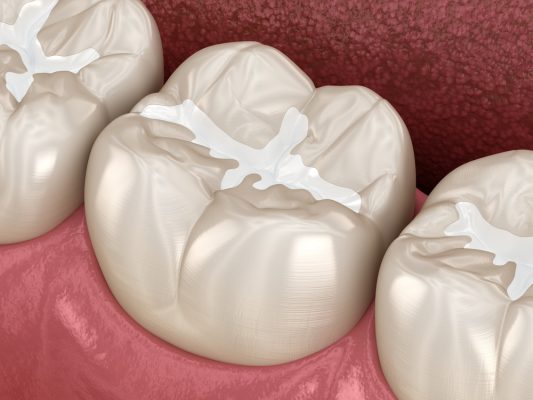 Composite fillings are tooth-colored restorations made from a blend of resin polymer and finely ground glass or ceramic particles. This combination produces a material that can be precisely shade-matched to your natural tooth color, making it virtually undetectable once placed. The material is applied directly to the tooth in a soft, pliable state, then hardened layer by layer using a specialized curing light.
What distinguishes composite from traditional amalgam (silver) fillings is not just appearance — it is also how the material interacts with tooth structure. Composite bonds chemically to enamel and dentin, which means the preparation requires less removal of healthy tooth material. This conservative approach helps maintain the structural integrity of the affected tooth over time.
Composite fillings can be used to address a variety of clinical situations, including:
- Small to medium cavities caused by tooth decay
- Chipped or fractured tooth surfaces
- Worn enamel from grinding or acid erosion
- Minor gaps or spaces between teeth
- Discolored or irregularly shaped teeth requiring cosmetic correction
Are You a Good Candidate for a Composite Filling?
Most patients with tooth decay or minor tooth damage are excellent candidates for composite fillings. The ideal candidate has a cavity of small to moderate size, sufficient healthy tooth structure remaining, and good overall oral hygiene habits. Patients who are committed to regular dental visits and daily brushing and flossing tend to see the best long-term outcomes from composite restorations.
Factors That May Affect Candidacy
There are some clinical situations where a composite may not be the optimal choice, or where additional treatment may be needed alongside a filling:
 Extensive decay: When decay has compromised a large portion of the tooth, a crown or onlay may provide better long-term coverage and support than a filling alone.
- Bruxism (teeth grinding): Patients who grind their teeth place excessive forces on restorations. While composite is durable, a nightguard may be recommended to protect the filling and extend its lifespan.
- Location of the cavity: Composite works well on both front and back teeth, but very large restorations on heavy-chewing surfaces in molars may sometimes benefit from more robust materials.
- Active gum disease: Periodontal issues should be addressed before restorative work to ensure proper healing and a stable foundation.
 Extensive decay
Dr. Wisk conducts a thorough clinical examination and uses digital X-rays to assess the full extent of decay before recommending any treatment. This ensures that every patient in Smyrna and the surrounding areas receives the most appropriate and effective restorative plan for their specific situation.
The Composite Filling Process at Glenwood Dental Associates
Receiving a composite filling at our Smyrna dental office is a straightforward, typically single-appointment procedure. Here is what patients can expect from start to finish:
- Examination and Diagnosis: Dr. Wisk reviews digital X-rays and conducts a visual examination to confirm the presence and extent of decay. If a composite filling is appropriate, the procedure is explained in full, and any questions are answered before treatment begins.
- Anesthesia: The area around the tooth is numbed with a local anesthetic to ensure you remain comfortable throughout. Most patients experience little to no discomfort during the procedure.
- Decay Removal and Tooth Preparation: Using precise instruments, Dr. Wisk removes all decayed material and prepares the cavity. The preparation is conservative by design — composite bonding requires far less removal of healthy tooth structure than amalgam.
- Bonding Agent Application: A mild etching solution and bonding agent are applied to the prepared surface to create the ideal foundation for the composite material to adhere.
- Composite Placement: The tooth-colored resin is applied in thin incremental layers. Each layer is shaped to the natural contours of the tooth and hardened using a curing light before the next layer is added.
- Shaping and Polishing: Once the filling is fully built up, Dr. Wisk checks your bite carefully and makes any necessary adjustments. The restoration is then polished to a smooth, natural finish that mimics the look and feel of real tooth enamel.
The entire process typically takes 30 to 60 minutes per tooth, depending on the size and location of the cavity. Most patients return to their normal routine the same day.
Caring for Your Composite Filling
Composite fillings are designed to be durable and long-lasting, but their lifespan is significantly influenced by how well you care for your oral health. With proper attention, most composite restorations last seven to ten years or more before requiring replacement.
Tips for Maximizing the Life of Your Filling
 Brush twice daily with a soft-bristled toothbrush and fluoride toothpaste, paying attention to the areas around the margins of the filling where plaque tends to accumulate.
- Floss daily to remove debris and bacteria from between teeth and along the gumline, which also helps catch early signs of new decay before it progresses.
- Avoid biting or chewing on excessively hard items such as ice, hard candy, or non-food objects, which can chip or crack the composite material.
- If you grind your teeth, wear a custom nightguard to protect your fillings and your natural teeth from wear.
- Limit highly staining foods and beverages such as coffee, tea, and red wine, as composite resin can absorb pigments over time and lose some of its initial brightness.
- Schedule regular dental exams and cleanings so Dr. Wisk can evaluate the condition of existing restorations and address any concerns before they develop into larger problems.
 Brush twice daily with a soft-bristled toothbrush and fluoride toothpaste, paying attention to the areas around the margins of the filling where plaque tends to accumulate.
Attending your six-month dental visits at Glenwood Dental Associates is one of the simplest and most effective ways to protect your investment in restorative dentistry. Early detection of wear, marginal leakage, or secondary decay around a filling allows for conservative intervention rather than more extensive treatment.
If you have a cavity or a damaged tooth that needs attention, do not wait. Contact Glenwood Dental Associates at (302) 653-5011 to schedule a consultation with Dr. Wisk. Our Smyrna dental team will evaluate your situation and determine whether a composite filling is the right solution for restoring your smile.
Common Misconceptions About Composite Fillings
Patients considering composite fillings often have questions based on outdated information or general misconceptions about restorative dentistry. Addressing these directly helps set realistic expectations and supports informed decision-making.
Myth: Composite Fillings Feel Different Than Natural Teeth
After initial placement, your bite may feel slightly different as you adjust to the new restoration. Any bite irregularities are typically corrected during the polishing step of the procedure. Within a day or two, most patients report that the filling feels entirely natural. Post-treatment sensitivity to temperature or pressure can occur briefly but should resolve quickly.
Myth: Composite Fillings Aren’t As Strong As Metal Fillings
Modern composite resins are significantly more durable than earlier generations of the material. While amalgam does have a slight advantage in raw compressive strength for very large restorations in high-load areas, composite performs excellently for small to medium cavities in all areas of the mouth, including molars. The bonding mechanism actually adds structural reinforcement to the tooth rather than simply filling space.
Frequently Asked Questions
Composite dental fillings typically last between seven and ten years, though many patients retain well-maintained fillings for longer periods. Longevity is influenced by several factors, including the size and location of the restoration, your oral hygiene habits, and whether you grind your teeth. Regular dental checkups at Glenwood Dental Associates allow Dr. Wisk to monitor your fillings over time and address any signs of wear before they become more significant problems.
Yes, in many cases. Patients who prefer the appearance of tooth-colored restorations and want to eliminate metal from their smile can discuss replacement options with Dr. Wisk. The decision is made on a case-by-case basis, considering the size and condition of the current restoration and the health of the surrounding tooth structure. Healthy, functioning amalgam fillings are not automatically replaced, but when a filling does need attention, composite is often the preferred alternative.
Most dental insurance plans provide coverage for composite fillings, though the extent of coverage can vary depending on your specific plan and the tooth being treated. Some plans cover composite at the same rate as amalgam for back teeth, which may leave a small portion as a patient responsibility. The team at Glenwood Dental Associates will help you understand your insurance benefits and review your coverage before treatment begins so there are no surprises.
The procedure is performed under local anesthesia, so most patients experience little to no discomfort during treatment. Some patients notice mild sensitivity to temperature or pressure in the days following placement, which is normal and typically resolves on its own within one to two weeks. If sensitivity persists or intensifies, it is worth contacting our Smyrna office so Dr. Wisk can evaluate the restoration and ensure everything is properly bonded and sealed.
Because composite fillings are hardened immediately with a curing light during placement, you can typically eat and drink normally as soon as the local anesthetic wears off — usually within a few hours. It is wise to avoid very hard or sticky foods for the first 24 hours and to be mindful of any temperature sensitivity during that initial adjustment period. Your daily routine, including normal meals, should be fully resumable by the following day in most cases.
Untreated decay does not resolve on its own — it progresses deeper into the tooth over time. A cavity that begins in the enamel layer will eventually reach the dentin, where it expands more rapidly and may cause sensitivity or pain. If decay reaches the inner pulp of the tooth, more extensive treatment such as a root canal or crown becomes necessary. Addressing decay early with a composite filling is almost always the simpler, less costly, and less invasive option compared to waiting.
Schedule Your Composite Filling Consultation in Smyrna, DE
If you have been told you need a filling, or if you have not had a dental checkup in a while and want to make sure your teeth are in good health, Glenwood Dental Associates is here to help. Dr. Brian Wisk and our experienced team are committed to providing comfortable, high-quality restorative care that protects your smile for the long term.
Call us today at (302) 653-5011 to schedule your appointment. We welcome patients from throughout the Smyrna area, as well as those traveling from Dover, Clayton, and Kenton. Please note that these are communities we serve — they are not additional office locations. Our Smyrna, DE, dental office at 17 West Glenwood Avenue is where all care is provided, and we look forward to welcoming you.